About
Dr. Minaeian
Artin Minaeian M.D. is a double board certified, general and vascular neurologist, practicing in Glendale, California. His hospital affiliations include Glendale Adventist Medical Center and USC Verdugo Hills Hospital, where he serves as the stroke program co-director.
Dr. Minaeian has received his medical degree from St. George’s University School of Medicine in 2009. He completed his medical training at Mt. Sinai school of medicine, general neurology residency at New York Medical college and vascular neurology fellowship at University of Massachusetts. Dr. Minaeian participates in multiple national and international clinical trials, as the principal investigator, including Dementias, Multiple Sclerosis, Parkinson’s disease, Migraine headaches and many more.
He has published articles in different journals and has presented his work at multiple American Academy of Neurology and other society meetings. Dr. Minaeian provides services to patients with neurological disorders, including but not limited to, Multiple Sclerosis, Dementia spectrum disorders including Alzheimer’s disease, Stroke, Headache spectrum disorders including Migraine headache, Seizure disorders, Parkinson’s disease and Traumatic Brain Injury (TBI).
Services provided include Botox Treatments for Migraine headaches, Muscular Spasticity related to Neurological Conditions, Trigger Point Injections for Neck and Shoulder, EEG (electroencephalography), Carotid ultrasound & Transcranial Dopplers Ultrasound Studies, and Home Sleep Study. Dr. Minaeian is fluent in Armenian, Farsi and Spanish.
OUR Services
How Can I Help You?

Memory and Dementia care and complete testing and workup
Memory and Dementia Care focuses on the evaluation, diagnosis, and management of conditions that affect memory, thinking, behavior, and daily functioning.
Botox for Migrane
BOTOX® is the first and only FDAapproved preventive treatment for Chronic Daily Migraine headaches.
It is an injectable form of treatment, performed once every three months.
Injections are performed by our physicians for patients who meet certain criteria.


ELECTROENCEPHALOGRAM (EEG)
A non-invasive procedure that measures the electrical activity of the brain, similar to an EKG.
It is utilized for patients with seizures, memory loss, headaches, syncope and ADHD.
Botox injections for TMJ and Bruxism
Botox injections can be an effective nonsurgical treatment for patients suffering from TMJ (temporomandibular joint) disorders and bruxism (teeth grinding or jaw clenching).
By relaxing overactive jaw muscles—primarily the masseter and temporalis muscles—Botox helps reduce muscle tension, alleviate jaw pain, decrease headaches, and minimize damage caused by chronic grinding.


Botox/Dysport/Xeomin injections for spasticity
Botox® (onabotulinumtoxinA), Dysport® (abobotulinumtoxinA), and Xeomin® (incobotulinumtoxinA) are FDA-approved injectable treatments used to help manage muscle spasticity, a condition characterized by involuntary muscle tightness, stiffness, and spasms.
Transcranial Doppler ultrasound (TCD)
Transcranial doppler ‘ultrasound’ (TCD) is a non-invasive imaging modality used to help in the diagnosis of conditions affecting blood flow within the brain.
It is used to screen patients with stroke, syncope, dizziness, aneurysm and other vascular malformations. It is also used for the surveillance of Sickle Cell disease.
%20.png)
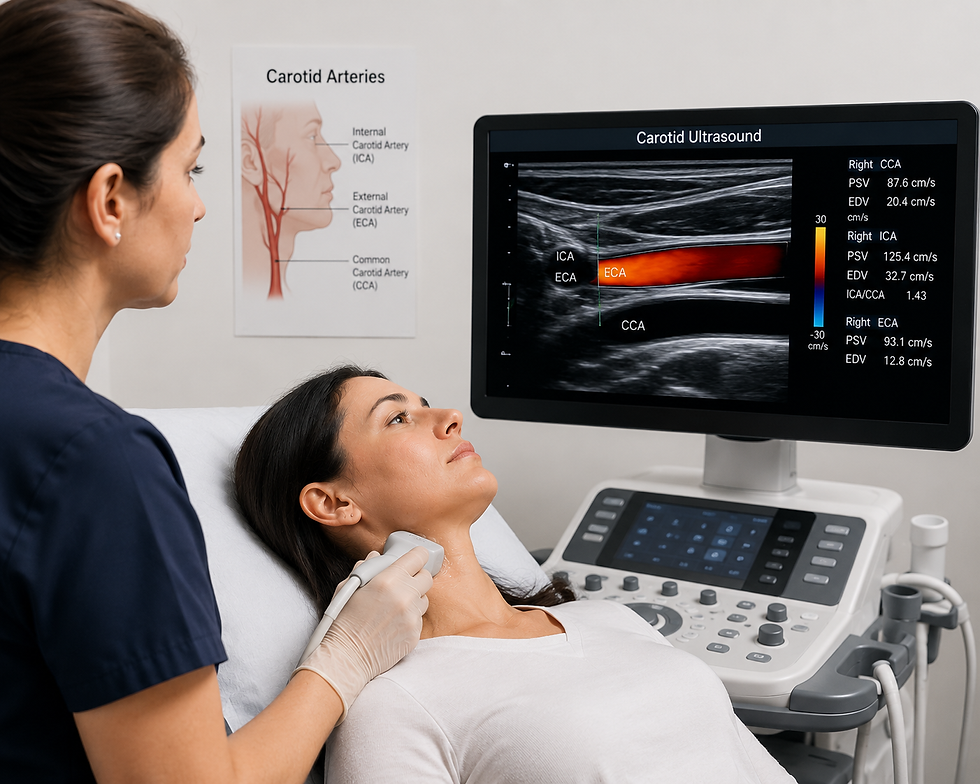
Carotid Ultrasound
Carotid ultrasound is a non-invasive imaging modality that produces images of the carotid arteries in the neck which carry blood from the heart to the brain.
It is most frequently used to screen patients for blockage or narrowing of the carotid arteries. It is used in patients with stroke, syncope and frequent or constant dizziness.
Trigger Point Injections
Muscle injections treat painful ‘knots’ for symptomatic relief. Very fine needles are used for these procedures.
The medication used is the common numbing medication, Lidocaine.